
KEYNOTE SPEAKERS

Rod Ellis — Curtin University (Perth, Australia)
Rod Ellis is an Emeritus Distinguished Research Professor in Curtin University (Australia), an Emeritus Distinguished Professor of the University of Auckland, a fellow of the Royal Society of New Zealand and in the top 1% of social and humanities scientists in the world. He has held teaching positions in universities in Zambia, UK, Japan, USA, New Zealand and Australia and has conducted talks and seminars throughout the world on second language acquisition and task-based language teaching.
Options in the design of a task-based language teaching curriculum: An educational perspective
I draw on the education literature to describe four educational curriculum models, which serve as a basis for presenting four TBLT curricula based on the proposals of Prabhu (1987), Willis (1996), Long (1985; 2015a; 2015b) and myself (Ellis, 2003 and 2019) – all of which have figured in the development of TBLT. I propose a set of questions that can be used to evaluate these models. I then turn to examine the curriculum design process, identifying options in TBLT curricula that are available at each stage of the process. I point to a tension that exists between what SLA theory indicates is needed and what instructional constraints make feasible and conclude with a plea for flexibility by weighing up which options are appropriate in different teaching situations. I also summarize how I see TBLT benefitting from adopting a broad education perspective that includes critical language pedagogy.
Keywords:
General educational curriculum models; four TBLT curricula; evaluating TBLT curricula; options in the design and implementation of TBLT; need for flexibility

Rosemary Erlam – University of Auckland/Waipapa Taumata Rau (New Zealand)
Rosemary Erlam is Associate Professor in the Faculty of Education at the University of Auckland. She has experience in working with teachers of modern foreign languages, equipping them to implement Task-Based language teaching in their specific contexts, as documented in her co-authored book (2022): The pedagogical realities of implementing task-based language teaching.
Tasks and teachers: understanding and implementing task-based language teaching in classroom practice
This presentation will showcase how teachers of languages other than English, understood and implemented task-based language teaching into their classroom practice. The teachers were working at a range of levels across the school educational context, although the majority of them were working with beginner language learners. Working from the premise that interaction facilitates language acquisition, the presentation will demonstrate how teachers created opportunities for students to use the target language to communicate. It will include information about students’ responses to these tasks. The presentation will also include examples of input-based tasks that created opportunities for students to notice key aspects of language, with no expectation that they produce language output, and an analysis of student learning in response to engagement with these tasks.
The presentation will consider the challenges that exist for teachers in implementing a task-based teaching pedagogy and suggest how language teacher education might adapt to address these and to cater for a range of educational contexts.
Keywords:
Task implementation in classroom practice; teacher cognition in TBLT; input-based tasks; meaning-focused interaction; beginner language learning
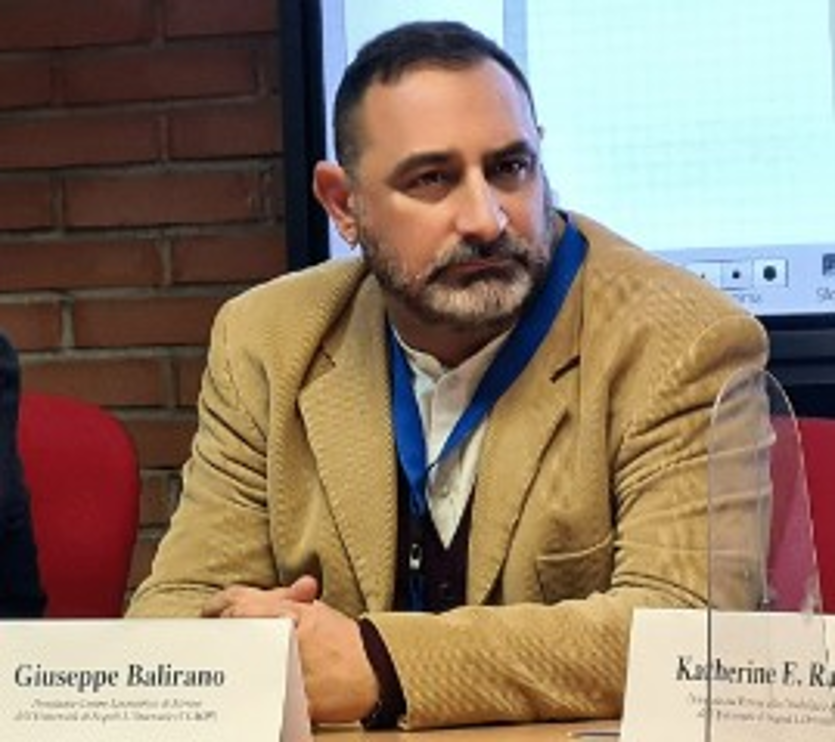
Giuseppe Balirano – University of Naples L’Orientale (Italy)
Giuseppe Balirano is president of the Italian Association of English Studies (AIA) and rector’s delegate for Lifelong Learning, eLearning and Multimedia Enhancement. His research focuses on critical discourse studies, online hate speech, identity construction and multimodal communication. He is principal investigator of the PRIN 2022 project Echoes of Hate and coordinates the UNIOR monitoring group on hate speech online. He is editor-in-chief of Textus and ALLIeD and has published extensively on digital discourse, gender, sexuality and audiovisual media.
The Changing Role of English in the Italian University: Task-Based Design for Discipline-Informed Language Education in the Age of AI
English language education in Italian universities is undergoing significant transformations. At the institutional level, an ongoing push towards ‘internationalisation’, often pursued without sufficient consideration of its educational implications, has contributed to the expansion of English-medium instruction. Beyond formal education, exposure to English through social media and streaming platforms has changed how the language is encountered and used. More recently, generative artificial intelligence has begun to reshape access to knowledge, text production and academic communication.
In this presentation, I examine how task-based design and implementation can respond to the changing role of English in Italian higher education. I focus on the capacity of tasks to connect language development with disciplinary knowledge and socially situated communication. This discipline-informed perspective is particularly relevant in large-enrolment environments and in courses addressing migration, discrimination and participation in digital society.
I draw on the design and implementation of an online course on hate speech developed within the ECHOES project for teachers of English. The course examines discriminatory discourse targeting migrants and other vulnerable groups, connecting English language education with critical digital literacy. Its learning pathway combines interactive learning objects with flipped preparation and structured debate. Participants analyse online hate speech, collaborate on position papers and produce multimodal counter-discursive responses for specific audiences. Gamified progression and automated feedback support participation within a scalable digital environment.
I also consider how generative AI is reshaping the design and evaluation of language tasks, and how task-based education can foster critical engagement with AI-generated discourse.
Through this experience, I argue that task-based design can connect English language education with disciplinary learning in large-enrolment contexts, while integrating generative AI into meaningful activities that require learners to evaluate discourse and make responsible communicative choices.
Keywords:
English in Italian higher education; task-based design; discipline-informed language education; generative AI; online hate speech
INVITED SPEAKERS

Carmen Argondizzo – University of Naples L’Orientale (Italy)
Carmen Argondizzo is Honorary Professor of English Language and Linguistics at the University of Calabria, Italy, where she currently teaches students majoring in Primary School Education. She previously served as Full Professor and President of the University’s Language Centre. She continues to devote a considerable amount of her professional life to AICLU, Associazione Italiana Centri Linguistici Universitari, within which she has held several roles: Secretary General (2010-2013), President (2013-2016, 2019-today). She served as Vice-President of CercleS (2016-2024). Since 2020, she has been Co-Editor-in-Chief of Language Learning in Higher Education (De Gruyter-Brill). Her research focuses on discourse analysis in Language for Academic Purposes and its pedagogical implications, approached from a humanistic perspective.
When Task-based Learning calls for Sustainable Actions and moments for reflection
Being invited to give a lecture at a conference focusing on the Task-Based Approach to language learning, as proposed by Rod Ellis, is a great honour for me. I was a very young teacher when I first started reading Ellis’s books, particularly those that encouraged readers to reflect on second language acquisition. Therefore, meeting the scholar who inspired me so much and having the opportunity to share my ideas with all the conference participants will be a truly important and memorable experience.
Guided by these emotions, my talk will take the form of a “show and tell” presentation, in which I will showcase language activities that have been successfully carried out with a group of lively and engaged learners. The activities have been selected around specific themes that will invite us to reflect on the principle that “learners deserve to be involved in meaningful actions”.
Overall, my contribution aims to demonstrate how Task-Based Learning can be effectively integrated with other learning approaches and, in particular, how it can contribute to fields of study that deserve to take centre stage in today’s educational landscape.
Keywords:
task-based learning (TBL), second language acquisition, sustainable actions, reflective practice

Sabrina Machetti — Università per Stranieri di Siena (Italy)
Sabrina Machetti is Full Professor of Educational Linguistics at the University for Foreigners of Siena and Director of the CILS (Certification of Italian as a Foreign Language) Centre. Her research interests include language testing and assessment, the teaching and learning of Italian as a S/FL, and language policy.
Rethinking Language Learning, Teaching, Assessment
This closing reflection considers the need to rethink how S/FL proficiency is conceptualised and assessed in contexts of situated language use. Scenario-Based Assessment (SBA), already explored in both Italian and international contexts, offers a complementary perspective by embedding language use within meaningful situations and social practices. The reflection will consider how SBA can extend task-based approaches and reshape the relationship between language learning, teaching, and assessment.
Keywords:
scenario-based assessment, situated language use, task-based approaches, language assessment

Nick Saville — Secretary-general of ALTE
Prof. Nick Saville has 45 years’ experience in language education, having started as an English teacher at the University of Cagliari in 1980. Building on broad interests in linguistics, second language acquisition and TEFL, he has specialised in language assessment since 1987. In Cambridge, he has held senior management and leadership roles, including as Director, Research and Validation, and currently Director, Thought Leadership. His interests include plurilingualism, LOA, impact by design and educational uses of AI. He is a visiting professor at the universities of Cagliari and Bedfordshire and is the elected Secretary-General of the Association of Language Testers in Europe.
Reimagining tasks at the heart of a transformative vision of language assessment
Tasks are fundamental to all forms of assessment, yet they are often shaped primarily by the practical demands of assessment systems, as exemplified by objective formats such as multiple-choice tests. For more than 50 years, however, advocates of communicative approaches have sought to operationalise more authentic tasks that elicit evidence of communicative ability. Although considerable progress has been made, resistance to change and practical barriers continue to constrain innovation. With the emergence of new technologies and the opportunities created by AI, what might a transformative vision look like in which tasks are placed at the heart of learning and assessment? How long might it take to implement such changes at scale? This reflective short talk will explore these questions.
Keywords:
task-based assessment, communicative assessment, artificial intelligence, assessment innovation