

Rod Ellis — Curtin University (Perth, Australia)
Rod Ellis is an Emeritus Distinguished Research Professor in Curtin University (Australia), an Emeritus Distinguished Professor of the University of Auckland, a fellow of the Royal Society of New Zealand and in the top 1% of social and humanities scientists in the world. He has held teaching positions in universities in Zambia, UK, Japan, USA, New Zealand and Australia and has conducted talks and seminars throughout the world on second language acquisition and task-based language teaching.
Options in the design of a task-based language teaching curriculum: An educational perspective
I draw on the education literature to describe four educational curriculum models, which serve as a basis for presenting four TBLT curricula based on the proposals of Prabhu (1987), Willis (1996), Long (1985; 2015a; 2015b) and myself (Ellis, 2003 and 2019) – all of which have figured in the development of TBLT. I propose a set of questions that can be used to evaluate these models. I then turn to examine the curriculum design process, identifying options in TBLT curricula that are available at each stage of the process. I point to a tension that exists between what SLA theory indicates is needed and what instructional constraints make feasible and conclude with a plea for flexibility by weighing up which options are appropriate in different teaching situations. I also summarize how I see TBLT benefitting from adopting a broad education perspective that includes critical language pedagogy.
Key words:
General educational curriculum models; four TBLT curricula; evaluating TBLT curricula; options in the design and implementation of TBLT; need for flexibility

Rosemary Erlam – University of Auckland/Waipapa Taumata Rau (New Zealand)
Rosemary Erlam is Associate Professor in the Faculty of Education at the University of Auckland. She has experience in working with teachers of modern foreign languages, equipping them to implement Task-Based language teaching in their specific contexts, as documented in her co-authored book (2022): The pedagogical realities of implementing task-based language teaching.
Tasks and teachers: understanding and implementing task-based language teaching in classroom practice
This presentation will showcase how teachers of languages other than English, understood and implemented task-based language teaching into their classroom practice. The teachers were working at a range of levels across the school educational context, although the majority of them were working with beginner language learners. Working from the premise that interaction facilitates language acquisition, the presentation will demonstrate how teachers created opportunities for students to use the target language to communicate. It will include information about students’ responses to these tasks. The presentation will also include examples of input-based tasks that created opportunities for students to notice key aspects of language, with no expectation that they produce language output, and an analysis of student learning in response to engagement with these tasks.
The presentation will consider the challenges that exist for teachers in implementing a task-based teaching pedagogy and suggest how language teacher education might adapt to address these and to cater for a range of educational contexts.
Key words:
Task implementation in classroom practice; teacher cognition in TBLT; input-based tasks; meaning-focused interaction; beginner language learning
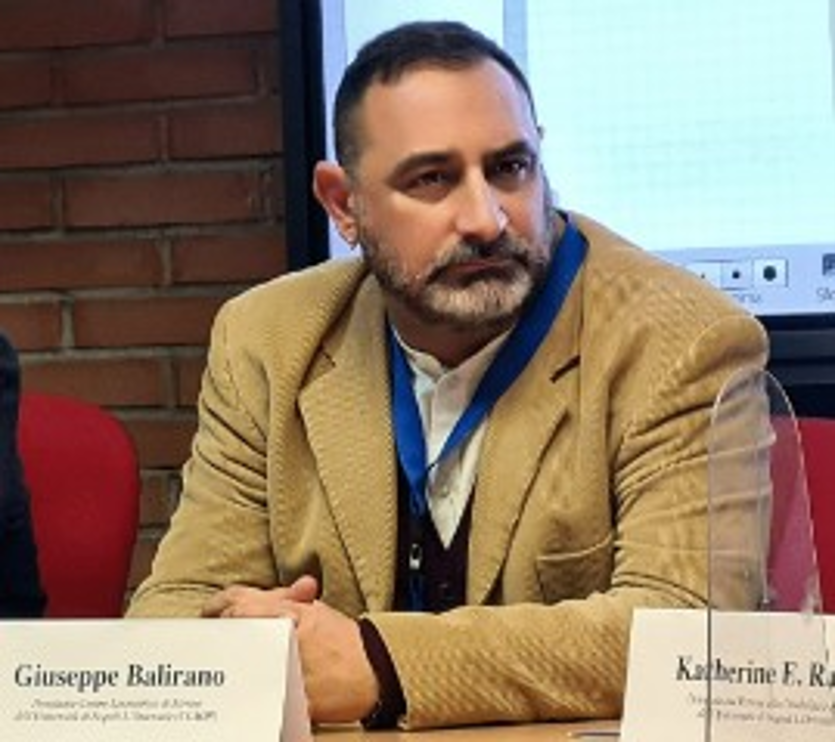
Giuseppe Balirano – University of Naples L’Orientale (Italy)
Giuseppe Balirano is president of the Italian Association of English Studies (AIA) and rector’s delegate for Lifelong Learning, eLearning and Multimedia Enhancement. His research focuses on critical discourse studies, online hate speech, identity construction and multimodal communication. He is principal investigator of the PRIN 2022 project Echoes of Hate and coordinates the UNIOR monitoring group on hate speech online. He is editor-in-chief of Textus and ALLIeD and has published extensively on digital discourse, gender, sexuality and audiovisual media.
The Changing Role of English in the Italian University: Task-Based Design for Discipline-Informed Language Education in the Age of AI
English language education in Italian universities is undergoing significant transformations. At the institutional level, an ongoing push towards ‘internationalisation’, often pursued without sufficient consideration of its educational implications, has contributed to the expansion of English-medium instruction. Beyond formal education, exposure to English through social media and streaming platforms has changed how the language is encountered and used. More recently, generative artificial intelligence has begun to reshape access to knowledge, text production and academic communication.
In this presentation, I examine how task-based design and implementation can respond to the changing role of English in Italian higher education. I focus on the capacity of tasks to connect language development with disciplinary knowledge and socially situated communication. This discipline-informed perspective is particularly relevant in large-enrolment environments and in courses addressing migration, discrimination and participation in digital society.
I draw on the design and implementation of an online course on hate speech developed within the ECHOES project for teachers of English. The course examines discriminatory discourse targeting migrants and other vulnerable groups, connecting English language education with critical digital literacy. Its learning pathway combines interactive learning objects with flipped preparation and structured debate. Participants analyse online hate speech, collaborate on position papers and produce multimodal counter-discursive responses for specific audiences. Gamified progression and automated feedback support participation within a scalable digital environment.
I also consider how generative AI is reshaping the design and evaluation of language tasks, and how task-based education can foster critical engagement with AI-generated discourse.
Through this experience, I argue that task-based design can connect English language education with disciplinary learning in large-enrolment contexts, while integrating generative AI into meaningful activities that require learners to evaluate discourse and make responsible communicative choices.
Keywords:
English in Italian higher education; task-based design; discipline-informed language education; generative AI; online hate speech